
White Papers
In July 2024, David Reid, delegate from Loudoun County, asked the Virginia Academy of Science, Engineering, and Medicine (VASEM) to provide “brief, unbiased, nonvested-interest scientific and engineering assessments” of a series of technologies being proposed to preserve Loudoun County’s place as the preeminent location for data centers in the world. Northern Virginia is the largest data center market in the world by total power consumption, housing almost half of the data centers in the United States, and Loudoun County, with over 230 data centers, is at its epicenter.
A principal challenge facing Loudoun County is sourcing the energy needed to support the construction of a new generation of data centers capable of supplying the computational power required by artificial intelligence and other uses.
Looking Ahead
The Virginia Academy’s record of accomplishment over the past 10 years has place it in an ideal position to reflect on its record. Now is the time to evaluate our efforts, expand on our successes, and pursue initiatives in areas where we have yet to realize our full potential. Our strategic plan is our roadmap for moving forward over the next five years.
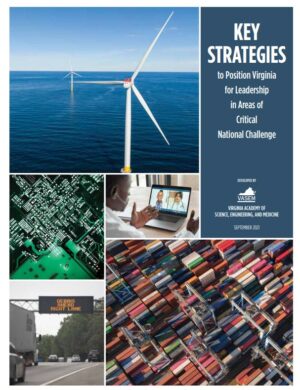
VASEM has not limited itself to projects proposed by other sources. In 2021, we took the initiative to develop a key strategy document, identifying five promising areas, such as sustainable energy production and semiconductors, in which the Commonwealth has the fundamental resources and expertise to achieve national prominence. We are currently in the process of updating and reissuing our report.
Studies
Virginia now confronts its fastest growth in electricity demand since World War II. With a forecast compounded annual growth rate of more than 5%, driven primarily by the growth of data centers in Northern Virginia, the Commonwealth’s electrical load will double over the next ten years and continue rising rapidly during the following decade. The Commonwealth’s challenge is to develop a strategy to meet this demand that is affordable, reliable, resilient, and sustainable.
To provide guidance on the technical challenges that must be overcome to meet these goals, VASEM convened some of the foremost experts in Virginia. They reviewed approaches for solar, wind, and natural-gas-power generation, along with energy storage concepts that could have an impact in the short term. They analyzed the many small modular reactor concepts that could have a significant impact in the mid- to long-term. And they addressed the equally important expansion of transmission and distribution network necessary to deliver electricity where it is needed. The result is a comprehensive study that addresses the complex technical issues that must be addressed to prepare for Virginia’s energy future.
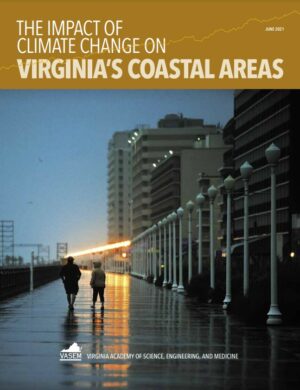
JCOTS asked VASEM to study the “safety, quality of life, and economic consequences of weather and climate-related events on coastal areas in Virginia.” After conducting its investigations, the expert committee found that climate change will have an increasingly disruptive effect on people living in Virginia’s coastal areas during the 21st century—and that these disruptions will have repercussions not just on the coasts but throughout the Commonwealth. An important finding of the report was that the consequences of these changes will be very different for rural and urban areas.
The expert committee issued several recommendations that included creating a state-wide body to coordinate and support critical data collection and technology transfer across the Commonwealth.
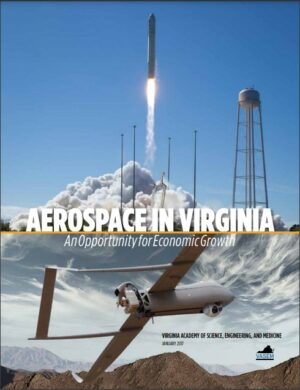
At the request of JCOTs, the Virginia Academy undertook a study of the aerospace industry in Virginia. After holding a series of all-day sessions and interviews with a score of stakeholders, the expert committee identified two growth areas— commercial space and unmanned aerial systems (UAS)—that held high promise for Virginia.
The expert committee found that these areas were among the fastest-growing segments of the aerospace industry, generating thousands of well-paying jobs, both directly and indirectly, and producing substantial growth for states encouraging their development. They determined that Virginia had compelling assets in both commercial space and UAS that could position it for leadership in these areas and made a series of policy recommendations to accelerate the development of these industries in the Commonwealth.